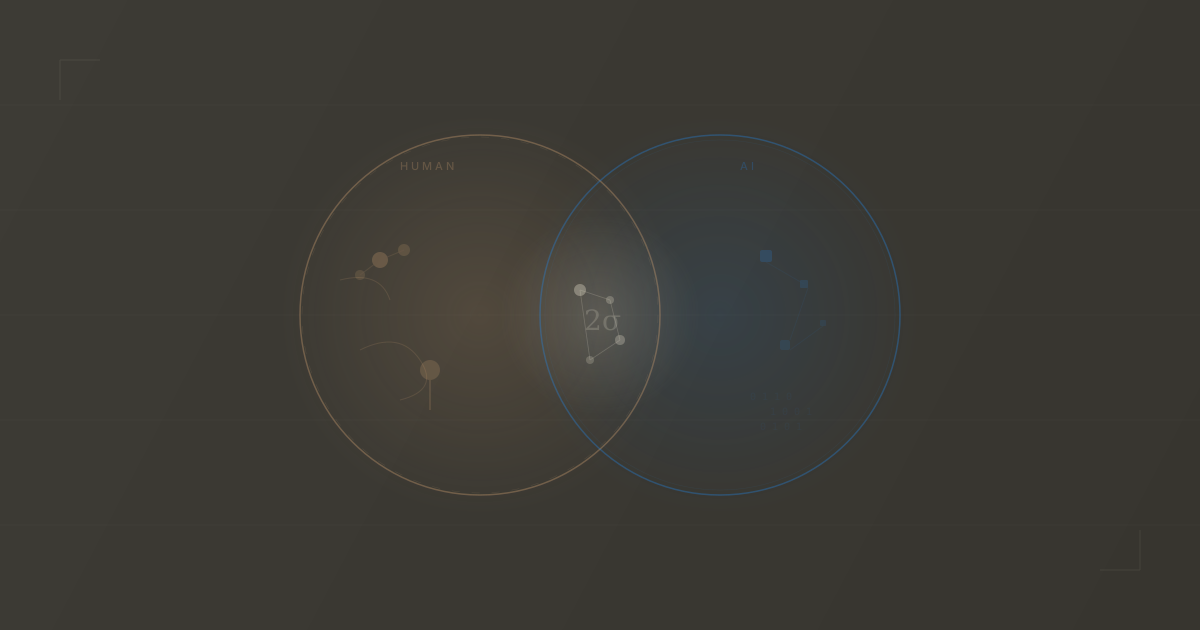
In 1984, educational psychologist Benjamin Bloom published a finding that would haunt education for four decades. Students who received one-on-one tutoring performed two standard deviations better than students in conventional classrooms — the "2 sigma" effect. In practical terms, the average tutored student outperformed 98% of students in a traditional class. The implication was clear and devastating: we knew the solution to educational inequality. We just could not afford it. Now, four decades later, AI seems to offer the answer — an infinitely patient, always available, endlessly knowledgeable tutor in every student's pocket. The 2-sigma problem, finally solved. Except that when researchers examine why tutoring actually works, they find something that complicates the AI narrative considerably.
What Tutoring Actually Is
When most people imagine tutoring, they picture content delivery: a knowledgeable adult explaining concepts one-on-one, adjusting pace and difficulty to match the student's level. AI does this remarkably well. But research on effective tutoring reveals something more complex.
Lepper and Woolverton's landmark 2002 study of expert tutors found that the most effective tutoring sessions were characterized not by superior explanations, but by superior relationships. Expert tutors spent significant time on non-content interactions: expressing genuine interest in the student's life, using humor, sharing their own learning struggles, and carefully calibrating emotional support.
VanLehn's 2011 meta-analysis confirmed this pattern: human tutoring consistently outperformed computer tutoring, not in the quality of explanations — which were sometimes equivalent — but in what researchers called "social scaffolding." Students tried harder, persisted longer, and took more intellectual risks with human tutors. Not because the content was better delivered, but because a relationship made the learning feel safe.
The Belonging Problem
The research on belonging in education is striking. Walton and Cohen's 2011 study showed that a brief belonging intervention — essentially helping students feel they were part of a community — closed the achievement gap between Black and white college students by 50% over three years. The mechanism was not cognitive. It was social and emotional.
Students who feel they belong approach academic challenges differently: with persistence rather than threat, curiosity rather than anxiety. A large language model cannot create belonging. It can simulate warmth and use encouraging language. But it cannot make a student feel genuinely seen by another person.
This matters because learning is not purely cognitive — it is profoundly social. We learn in relationship, and the quality of that relationship determines the depth of the learning.
“Bloom's 2-sigma problem was never really about content delivery. It was about what happens when a caring adult pays close attention to a single learner's mind. AI can simulate the first part. It cannot simulate the second.”
The Paradox of Personalization
Here is the uncomfortable paradox: the more we personalize education through AI, the more we risk isolating learners from the social context that makes learning powerful.
Consider the typical AI tutoring scenario — a student alone with a screen, receiving individually tailored content at an individually optimized pace. This is excellent for certain types of skill building: vocabulary acquisition, math fact fluency, procedural knowledge. But it removes three elements that research identifies as critical to deep learning.
First, peer interaction — Vygotsky's zone of proximal development depends on social engagement with more capable peers. Second, productive struggle in community — watching classmates wrestle with the same problem normalizes difficulty and builds resilience. Third, identity formation — students develop academic identities through social mirrors, seeing themselves reflected in teachers and peers who value intellectual growth.
The most effective use of AI tutoring, then, is not as a replacement for human instruction but as a complement — handling the skill building that benefits from individualization while freeing human time for the relational, communal aspects of learning that benefit from togetherness.
The Real Two-Sigma Solution
If AI can deliver the content-individualization component of tutoring, and human teachers can deliver the relational component, the real 2-sigma solution might look like this: AI handles differentiated practice, immediate feedback, and content remediation — the tasks where infinite patience and around-the-clock availability genuinely help. Teachers, freed from these tasks, invest their time in Socratic dialogue, mentorship, community building, and modeling expert thinking in real time.
This is not a compromise. This is potentially better than pure one-on-one tutoring, because it combines the personalization that AI provides with the communal learning that a classroom of peers enables — something even the best private tutor cannot replicate.
The 2-sigma trap is believing that the sigma comes from personalization alone. It does not. It comes from personalization embedded in relationship. The challenge for educators is not to choose between AI and human teaching, but to architect systems where each does what it does best — and where no student is left alone with a screen when what they need is a person.
Martin & Claude Opus 4.6
Martin is the founder of Deskmate. These articles were co-written with Claude Opus 4.6, exploring the intersection of artificial intelligence and classroom practice through deep research and genuine dialogue.